

 Facebook
 X
 Pinterest
 Copy Link
We’ve all read the headlines and know interest rates and inventory are up. In fact, rates are up by 1% from a year ago, and inventory is up year-to-date (YTD) 2026 over 2025 in King and Snohomish counties by 39%. These two factors have led to more price and credit negotiations for buyers and further opportunity to do inspections and due diligence. Many sellers are sitting on large amounts of equity, allowing for negotiations to complete a sale and meet the current market conditions, resulting in a great return. Buyers are enjoying added selection and more time to make big decisions. This is what happens in a more neutral market compared to the intense seller’s market we recently experienced.
The news that hasn’t clearly come to the forefront is how negotiations are playing out to create sales. My office tracks the detailed contract data metrics for our pending sales, which highlights terms such as financing type, down payment amounts, inspection concessions, and seller-paid buyer credits, to name a few. Gathering these insights is crucial to help us understand how transactions are being put together to create win-wins for both buyers and sellers. In our most recent data pull, 38% of our pending transactions had a seller-paid buyer credit, averaging $13,000.
Seller-paid buyer credits can be used to offset the money required for out-of-pocket closing costs. Putting more liquid cash in the hands of the buyer to freshen up or care for their new home, or keep a nest egg. It can also be used to buy down the buyer’s interest rate, in turn lowering their monthly payment and helping with affordability. There are different types of buydowns: a permanent buydown or a variable buy-down such as a 2-1 buydown.
A permanent buydown requires about 3% of the purchase price to buy the rate down by a point for the 30-year term of the loan. This 3% differential is close to the average List-to-Sale-Price Ratio (LP/SP%) of 98% on closed sales in King and Snohomish counties for Single-Family Residential (SFR) Homes month-to-date (MTD) in October 2026. The latest LP/SP% shows that a negotiation of this sort is not out of line with the trends. Using the example of an $800,000 purchase price, a 3% credit would be $24,000.
A good rule of thumb to remember is that every 1-point in rate equals 10% in buying power. For example, the current rate (as of 10/27/26) is 7.32%, and if you are qualified for a home at $800,000, if the rate went down by 1 point to 6.32%, you could now afford $880,000 and have a very similar payment. A more strategic way to look at this is simply the monthly payment itself. An $800,000 purchase with 20% down with a 6.32% interest rate would save a buyer $427 a month on their principal and interest (P&I) payment vs. the payment at 7.32%. Also worth noting, you don’t need 20% down to buy a house. Down payments can vary up or down, and the 20% down is for illustrative purposes only.
A permanent buy-down is a useful tool, and so is a temporary buy-down. The typical homeowner owns their property for 11 years before selling, according to the National Association of REALTORS®. While mortgage rates will fluctuate during that time, buyers today may have an opportunity to negotiate seller concessions that lower their initial housing costs. A seller-paid 2-1 buy-down can provide meaningful payment relief during the first two years, with the possibility of refinancing later if market conditions become favorable. It is actually one of the most powerful tools in today’s market. It costs far less than a permanent buy-down and resets the payments considerably for the first two years of the loan.
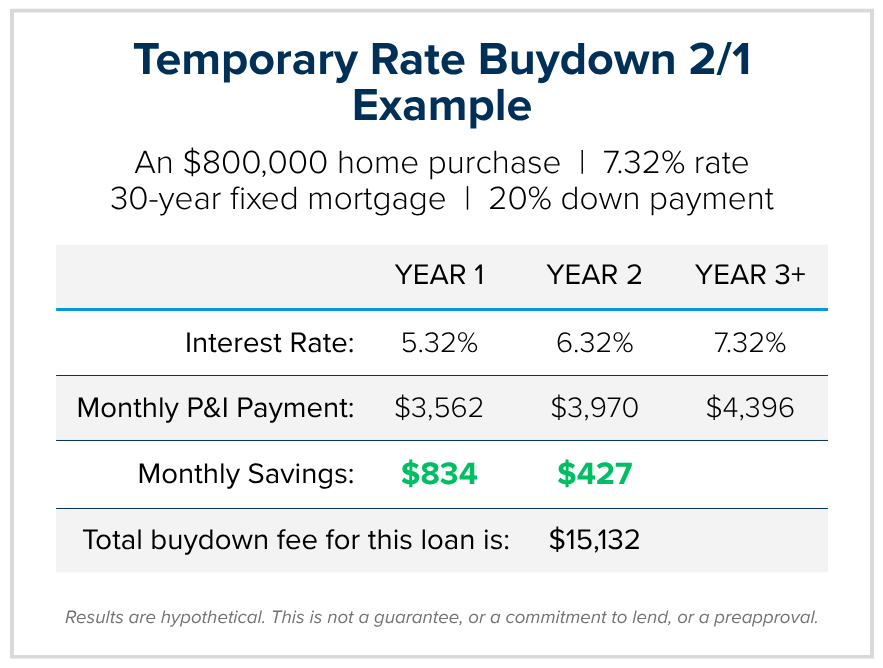
Here is an example: let’s say you are shopping for a house and have the same $800,000 budget and a 20% down payment with today’s rate of 7.32%. The monthly P&I payment at 7.32% would be $4,396. You could do a 2-1 buy-down (2 points lower in year one and 1 point lower in year two), which would have your payment in year one be based on an interest rate of 5.32% with a monthly P&I payment of $3,562 — a savings of $834 a month. For year two, the monthly P&I would be based on 6.32%, resulting in a monthly payment of $3,970, a $427 savings per month. The total savings in monthly payments with the 2-1 buy-down over the two years would be $15,132.
The roughly $15,000 in monthly payment savings is paid upfront at closing and, in some cases, paid by the seller via a seller-paid buyer credit that is negotiated. The buyer still needs to qualify based on the 7.32% interest rate, as the payments will convert to the payment based on the 7.32% in year three moving forward. Additionally, the home needs to appraise at the agreed-to purchase price with the credit baked into the contract. If during that two-year period the home buyer witnesses lower rates that they would be willing to refinance to in order to permanently fix their rate, they could do so. A bonus is that if the entire $15,000 credit has not been used yet, in some cases those funds can be applied towards the refinance costs.
This strategy has been effective in helping buyers secure a monthly payment that is more affordable so they can make a move now based on life’s needs and wants. It can help a renter become a homeowner, secure a move-up home for a growing family, or fuel a relocation due to life changes. With longer market times and increased inventory, we are finding that some home sellers are likely to assist with a credit for a 2-1 buy-down or the larger 3% credit to accommodate a lower payment for 30 years. The temporary assistance in reducing the payment for 1 to 2 years with the 2-1 buy-down is a viable tool for both the buyer and seller to create a win-win.
After several years of tight inventory, rapid price growth, and fewer negotiations, this is a welcome tool to assist home buyers with affordability and for sellers to meet the current market conditions to make a sale. This requires nuance and keen analysis by the listing broker, buyer broker, and a trusted lender, as the appraisal needs to line up with the purchase price for the credit to work. Some homes are still selling quickly without much negotiation based on the home’s condition, presentation, and accurate pricing. Many more homes are being sold with credits baked into the contracts to assist with affordability given the pressure of higher rates. That is why we track these contract metrics, so we can bring the latest information to both our buyers and sellers so they are equipped to make informed decisions.
If you are curious about how this shifting market aligns with your housing goals, please reach out. For buyers, connecting you with a skilled lender who can outline different options that fall within your current and long-term budget matters. For sellers, leading with the most current market data and helping prepare your home for market matters more than ever. I am happy to dig into your goals, apply the data, and supply you with useful tools to help you obtain the housing that is the best fit for your life according to your budget and financial picture.

Welcome to Know Your House: Roofs 101 🏠
Knowing your home starts at the top! Take a closer look at your roof, from common materials and expected lifespans to maintenance tips and warning signs. Whether you’re caring for your current home or considering your next one, understanding what’s overhead can help you plan ahead and protect your investment.
ROOF TYPE
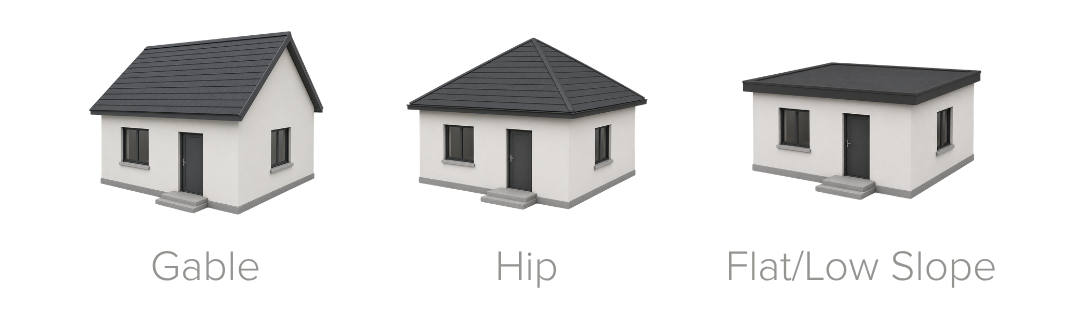
Gable: Two sloping sides that meet at a ridge. Simple, common, and effective at shedding rain.
Hip: Slopes downward on all four sides. Often sturdy in wind and creates a more compact roofline.
Flat / Low-Slope: Common on modern homes and additions. Requires a different drainage and roofing approach than steeply pitched roofs.
ROOF MATERIAL
Asphalt Composite Shingles: One of the most common residential roofing materials. They’re popular because they are relatively affordable, they are available in many colors and styles, they are straightforward to repair or replace, and they work well on many traditional roof shapes.
Metal: Durable, lightweight, and increasingly popular. Particularly good at shedding rain and snow.
Wood Shake or Shingles: Beautiful and natural, but typically require more maintenance and attention to moisture, moss, and fire considerations.
Tile: Long-lasting and distinctive, but considerably heavier than many other roofing materials, so the home must be designed to support it.

ROOF LIFESPAN
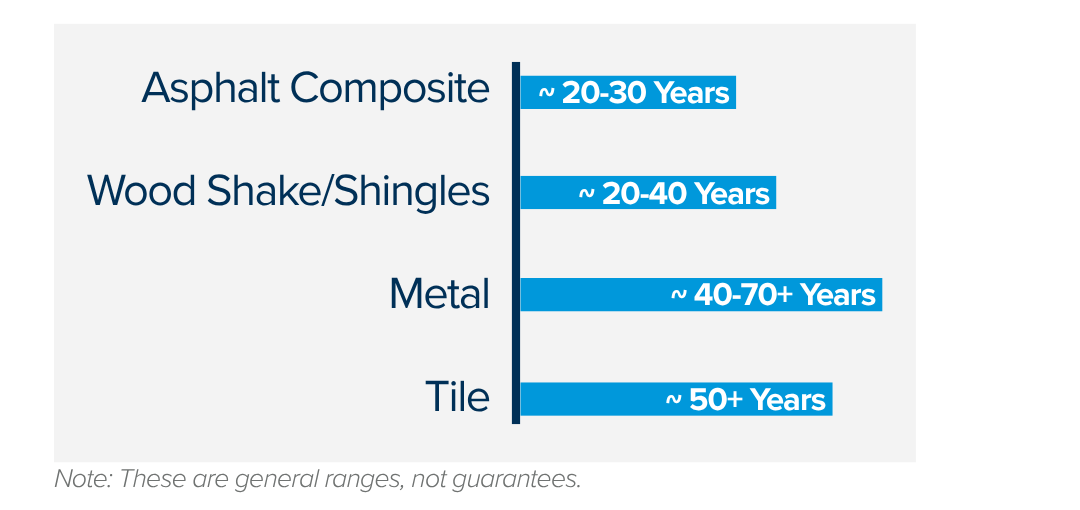
Different roofing materials come with very different expected lifespans, but age is only part of the story. Installation quality, ventilation, maintenance, surrounding trees, sun exposure, and our Northwest climate can all affect how quickly a roof wears.
Signs your roof may be aging: The calendar isn’t the only thing to watch. Be on the lookout for:
- Curling, cracked, or missing shingles
- Granules collecting in gutters
- Moss that keeps returning
- Damaged flashing
- Sagging or uneven areas
- Water stains or signs of moisture inside
Note: Visible wear doesn’t always mean full replacement, but it’s worth having evaluated.
ROOF MAINTENANCE
Roof maintenance doesn’t have to mean climbing onto your roof every weekend. A few simple consistent habits can go a long way toward protecting one of the most important parts of your home.
Start with a visual check: A few times a year, from the ground look for:
- Missing, cracked, or curling shingles
- Visible moss or debris buildup
- Sagging or uneven areas
- Damaged flashing
- Anything that looks noticeably different than before
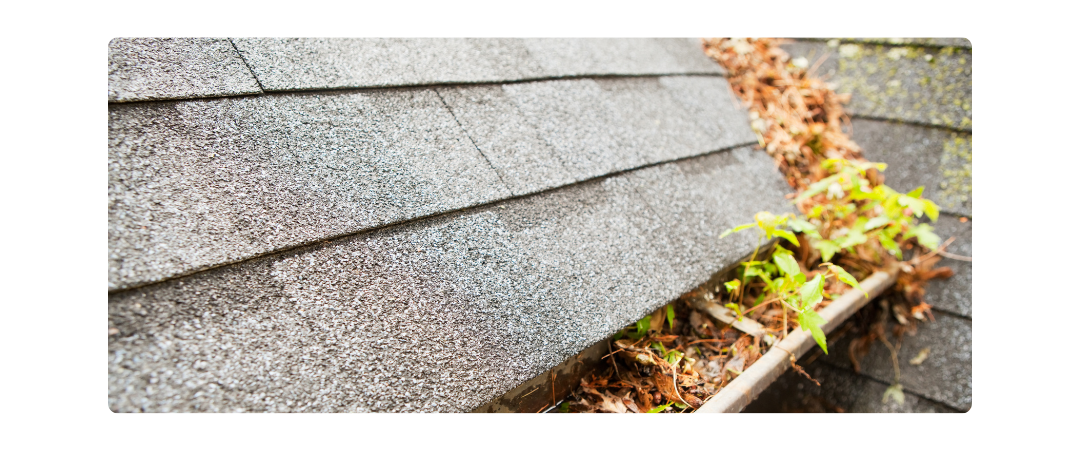
Keep water moving where it should: Leaves, needles, and debris can block gutters and collect in roof valleys, especially around mature trees. Clear buildup regularly so rainwater can drain freely and away from the house.
Stay ahead of moss: A little moss growth can become a bigger problem if it holds moisture against the roof surface. The best approach is to treat it early, and avoid aggressive scraping or pressure washing that can damage your roofing materials.
Trim overhanging branches: Give your roof some breathing room. Keeping nearby trees maintained can make your roof care much easier. Branches hanging over the roof can:
- Drop leaves and needles
- Encourage moss and moisture
- Rub against roofing materials
- Increase storm-related damage
Know when to call a pro: Consider a professional roof inspection if:
- You notice visible damage
- Your roof is getting older
- You’ve had a major wind or storm event
- You’re seeing signs of moisture inside
- You’re preparing to sell
